

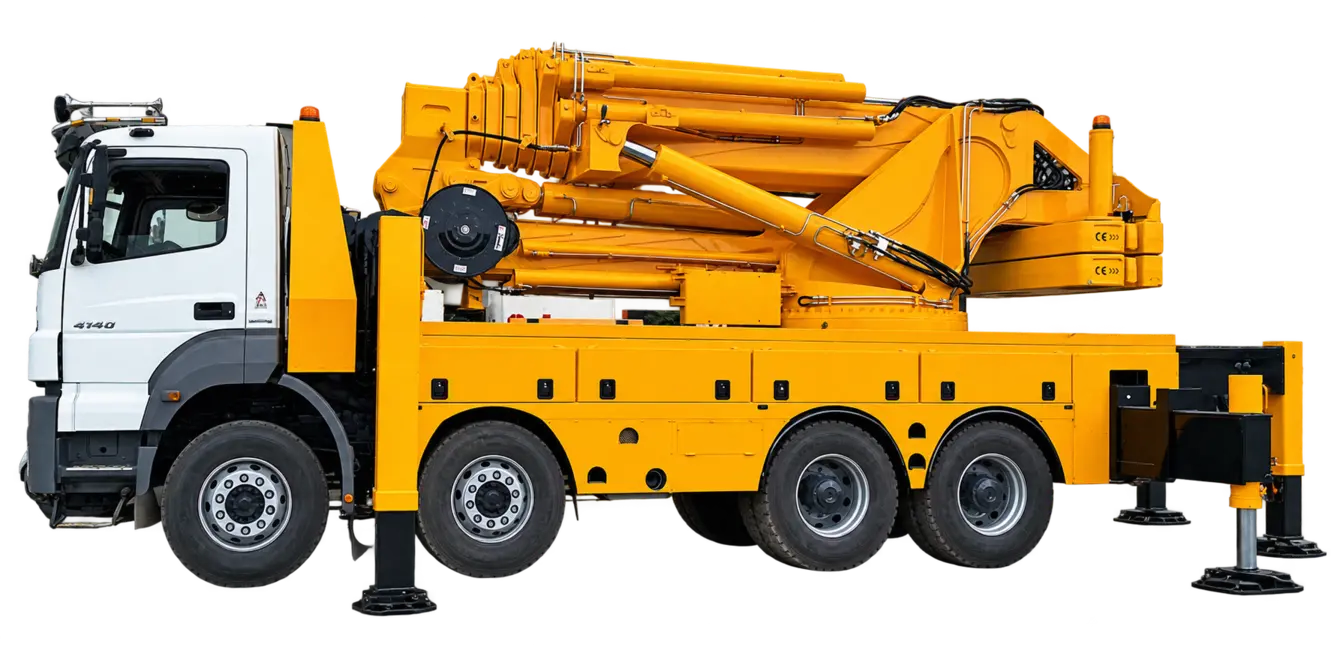

Many crane accidents stem from preventable causes: misjudged ground conditions, an ignored load chart or a breakdown in communication within the crew. In this article, we've compiled the essential safety rules to follow when working on site with truck-mounted hydraulic cranes, laid out as a practical checklist.
Plan before you lift
A safe lift starts before the crane arrives on site. For heavy, long or unusual loads in particular, a written lift plan is recommended. It should cover:
- The load's weight, center of gravity and attachment points
- Where the crane will be set up and its working radius
- The slings, chains and accessories to be used
- Obstacles and power lines in the work area
- Crew roles and the communication method
Ground conditions and outriggers
One of the most common causes of crane tip-overs is ground that can't support the load under the outriggers. Backfilled soil, freshly excavated areas, manhole covers and ground softened by rain are especially risky.
- Always deploy the outriggers as specified in the manual and level the crane.
- Place pads that are large and strong enough to spread ground pressure under the outrigger feet.
- Avoid setting up close to the edges of excavations and slopes.
- When the outriggers can't be fully extended, work only with the load values that apply to that configuration.
Always follow the load chart
The load chart shows how much the crane can lift at each distance and is the key reference for every operation. Remember that the weight of the hook block and rigging must be added to the load. The overload protection system is an important layer of safety, but it doesn't replace the load chart and must never be bypassed.
Rigging rules
Even a properly set-up crane can become dangerous if the load is rigged incorrectly. Keep these rules in mind when rigging:
- Make sure slings, chains and shackles carry a tag showing the working load limit and are free of damage.
- Remember that the force on each sling leg increases as the sling angle widens; avoid very wide angles.
- Protect slings with edge protectors on loads with sharp edges.
- Lift the load just a few centimeters first to check its balance and the rigging, then continue the lift.
Wind and weather
Wind can make loads swing and put more stress on the crane than expected, especially with large-surface loads such as panels, glass and sheets. Don't lift when the wind exceeds the permissible speed stated in the manufacturer's manual. Keeping an anemometer on site or following a reliable weather source is good practice. Operations should also be postponed in heavy fog, storms or when there is a risk of lightning.
Watch out for power lines
Contact with overhead power lines is one of the deadliest types of crane accidents. Electricity can arc across a gap without the boom ever touching the line.
- Identify all overhead lines on site before starting work.
- Keep the safe approach distance that applies to the line's voltage.
- If a safe distance can't be maintained, contact the local utility to request a shutdown or insulation.
- Always assign a signal person when working near power lines.
Signal person and communication
Whenever the operator can't see the load clearly at all times, a trained signal person should be assigned. The operator and signal person should agree on standard hand signals or radio communication before the work begins. Only one person should give commands at a time, but anyone on site can call a stop.
Securing the work area
- Cordon off the crane's slewing area and the load's travel path with barriers or tape.
- Never allow anyone to stand under a suspended load.
- Use tag lines to guide the load instead of handling it directly.
- Make personal protective equipment (hard hat, safety shoes, gloves, high-visibility vest) mandatory.
Operator competence
Cranes should only be operated by trained, competent operators. In Türkiye, the applicable regulations generally require a vocational qualification certificate for work classed as hazardous, such as crane operation. Beyond the certificate, operators should also receive training specific to the crane model they use and know its operating manual.
Frequently asked questions
At what wind speed should a crane stop working?
The limit varies with the crane model and the load's surface area. The correct value is given in the manufacturer's manual; with large-surface loads, risk can arise even at lower wind speeds.
If there's an overload system, do I still need the load chart?
Yes. The overload system is a backup safety measure. Every lift should be planned according to the load chart.
Who should carry out the daily crane check?
The daily visual check is usually done by the operator before starting work. Statutory periodic inspections are carried out by authorized persons.
For risky or complex lifts, working with an experienced crew greatly improves safety. Explore our heavy lifting and transport and hydraulic crane rental services, or contact us with any questions.


